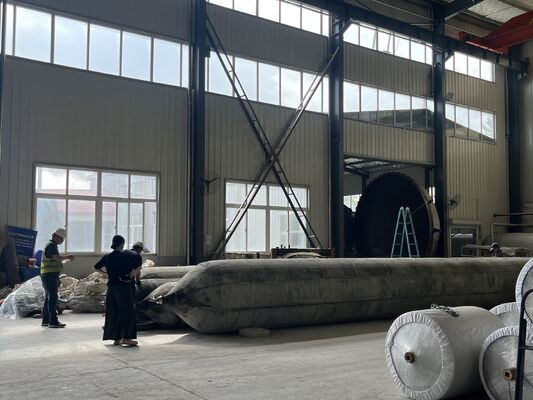
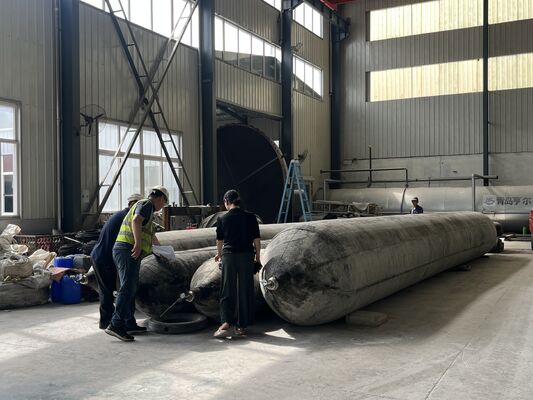
Marine Rubber Airbag – Where Raw Power Meets Controlled Buoyancy
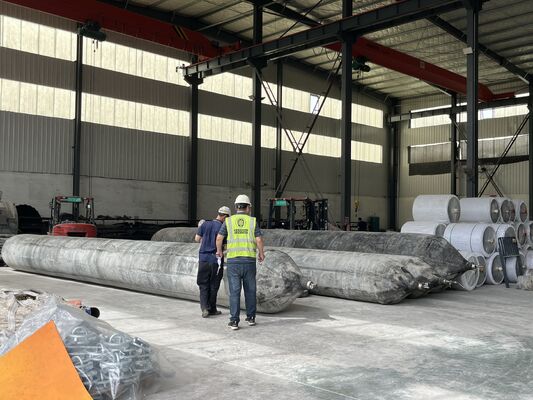
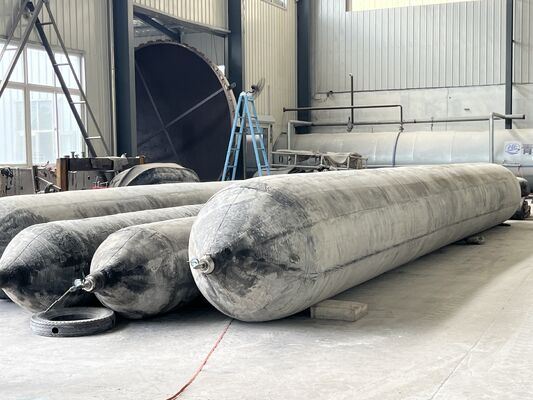
When a vessel must glide from slipway to sea, when a grounded hull needs to rise, or when a multi‑ton load must move across unforgiving ground, the difference between success and setback often comes down to one dependable tool. Our Marine Rubber Airbag is that tool – a natural‑rubber inflatable engineered for ship launching and landing, salvage refloating, and heavy‑load shifting. It is not merely a rubber cylinder; it is a calibrated pressure vessel built to deliver repeatable force where and when you need it.

The Material Story
We start with premium natural rubber, selected for its high tensile strength, tear resistance, and ability to recover after repeated compression. Into the rubber matrix we embed multiple plies of high‑tenacity synthetic cord, creating a composite wall that resists burst, abrasion, and fatigue. The result is an airbag that carries enormous radial loads while remaining flexible enough to conform to hull curves and uneven slipway surfaces. At each end, stainless steel fittings are fitted as standard, providing corrosion‑resistant anchor points for inflation, towing, and handling.
Certification and the Pressure Envelope
Every unit is manufactured to ISO 14409, the international reference for ship launching airbags. The rated working pressure is 80 kPa, a level that balances lifting capacity with safe, controllable inflation. This pressure envelope allows the airbag to support vessels and structures across a wide weight range without sacrificing stability. Whether you are launching a newbuild or refloating a casualty, the 80 kPa rating gives you a predictable, repeatable performance baseline.
Customisation Without Compromise
No two yards or salvage sites are identical. That is why we offer full dimensional customisation: diameters from 0.4 m to 3 m, and lengths from 5 m to 25 m. This range covers everything from compact workboat launches to heavy‑lift projects involving large hull sections. Stainless steel end fittings remain the default, but we can adjust fitting configuration to suit your inflation and rigging arrangements. Every custom size is built to the same ISO 14409 discipline – customisation never means cutting corners.
The Factory Quality Gate
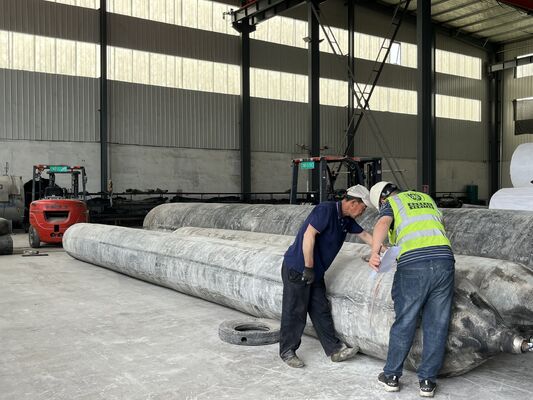
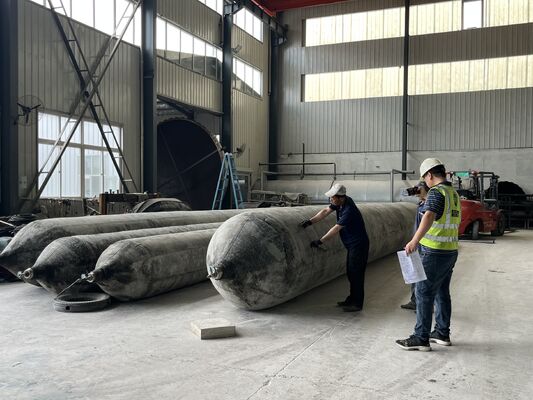
Before any airbag is deflated and packed, it must pass a comprehensive factory quality test. We verify pressure retention, inspect the rubber surface for defects, and confirm dimensional accuracy. Only after the unit has demonstrated stable performance under test does it receive clearance for packing and shipment. This gate exists because we know that a failed airbag at the slipway is not an inconvenience – it is a safety event. Our test protocol is our promise that the product you receive has already proven itself.
Three Duties, One Platform
- Ship launching and landing: the airbags act as rolling supports, distributing hull weight and reducing friction so the vessel moves smoothly and predictably.
- Salvage and refloating: inserted beneath a stranded or submerged hull, the airbags inflate to provide controlled buoyancy for lifting and tow‑out.
- Heavy load shifting: used as rollers or lifting cushions for offshore structures, concrete sections, and industrial equipment, replacing complex crane rigging with simple, low‑friction movement.
Warranty and Support
We back the Marine Rubber Airbag with an 18‑month warranty against manufacturing defects. Our technical team supports installation planning, inflation procedures, and maintenance scheduling. With routine inspection and proper storage, the airbag delivers years of service across multiple projects.
Choose a marine airbag that has passed the test before it ever reaches your site – and that carries ISO 14409, 80 kPa performance, and stainless steel end fittings as standard.

 english
 français
 Deutsch
 Italiano
 Русский
 Español
 português
 Nederlandse
 ελληνικά
 日本語
 한국
 العربية
 हिन्दी
 Türkçe
 indonesia
 tiếng Việt
 ไทย
 বাংলা
 فارسی
 polski